


Step through the mirrored mahogany doors of a 1920s British parlour or subterranean Mayfair jazz club, and one thing becomes instantly unmistakable: women’s clothing underwent the most ferocious, liberating, and poetic metamorphosis in textile history. To ask what did women wear in the 1920s is not merely to ask about hemlines or beadwork; it is to explore how modern womanhood cast off the physical shackles of nineteenth-century domesticity in favour of speed, syncopation, and athletic self-possession.
For centuries, the feminine form had been carved into artificial geometry by steel-boned stays, bustle cages, petticoat layers weighing upwards of ten pounds, and suffocating high collars. Then came the shockwave of the Great War, female enfranchisement, and the hum of motorcar engines. Almost overnight, fashion discarded its architectural weight. Out went the pigeon-breasted Edwardian matron; in strode the lithe, dynamic garçonne, striding down Piccadilly with a cigarette case tucked into her velvet reticule and her skirts swaying cleanly around her calves.
Whether you are an ardent vintage collector, a 1950s pin-up aficionado seeking to broaden your historical silhouette repertoire, or a bride orchestrating an Art Deco celebration, understanding true Roaring Twenties dress reveals a nuanced tapestry. Away from the synthetic fringe and neon plastic beads of cheap Halloween fancy dress lies a magnificent heritage of whisper-light silk georgette, sculptural cloche millinery, boyish knitwear, and intricate hand-embroidery. Let us pull back the velvet curtain on what everyday women, rebellious flappers, and high-society tastemakers truly wore during this dazzling, transformative decade.
The Silhouette Revolution: How the 1920s Redefined the Female Form
To appreciate 1920s fashion, one must first understand the fundamental architectural overthrow that preceded it. Until roughly 1918, high-fashion dressmakers constructed garments around an idealised hourglass or the severe S-bend silhouette championed by Charles Dana Gibson's illustrations. Waistlines were compressed, bosoms were pushed upward and forward, and hips were padded to create dramatic contrasts. The 1920s systematically shattered every single one of those anatomical rules.
In place of the pinched waist arrived the tubular silhouette—a sleek, columnar, and intentionally drop-waisted form that allowed fabric to fall straight from shoulder to hip without cinching. Popularised in Paris by revolutionary couturiers such as Gabrielle "Coco" Chanel, Jean Patou, and Jeanne Lanvin, this aesthetic drew inspiration from Cubism, machine-age aerodynamics, and the streamlined grace of neoclassical art. The cultural archetype became known across Europe as La Garçonne, christened after Victor Margueritte’s controversial 1922 French novel of the same name.
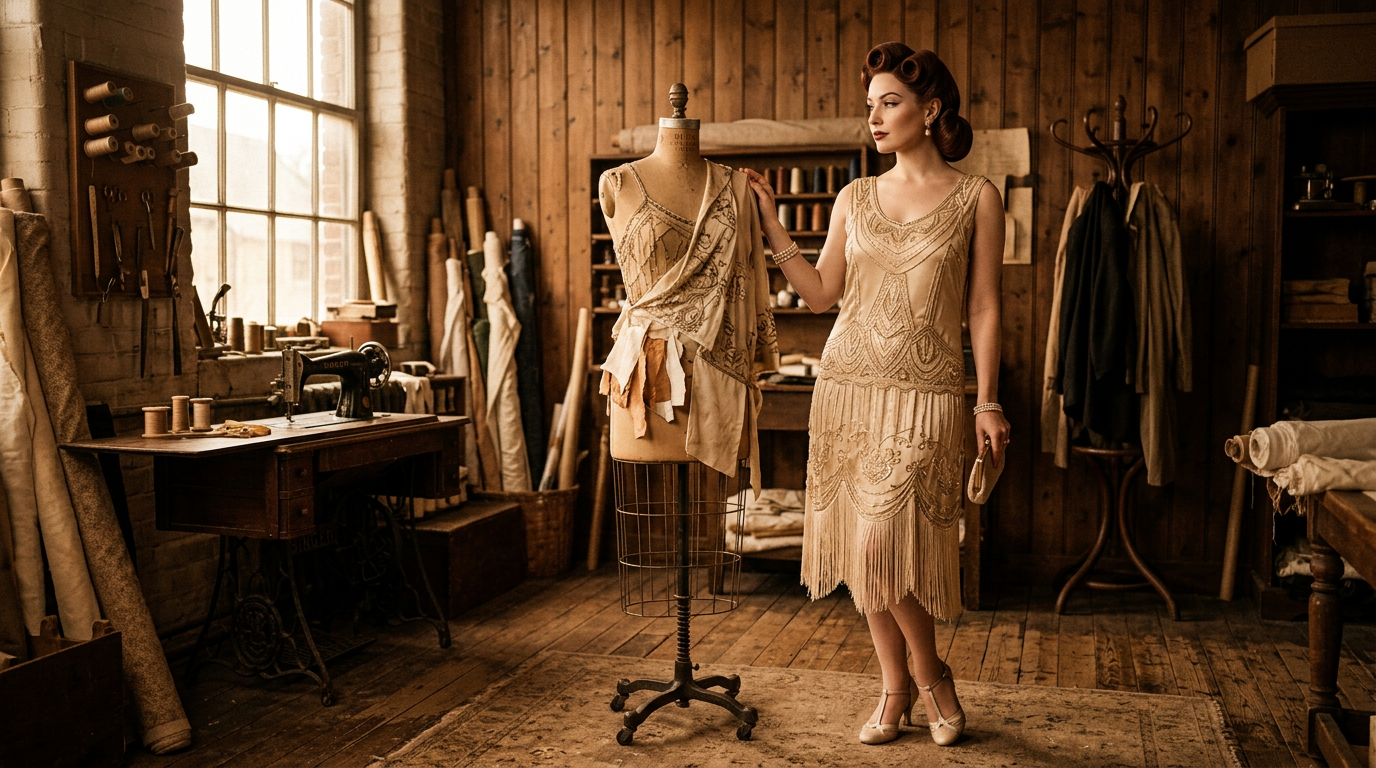
The feminine waistline dropped dramatically down to the high hip or upper thigh, held visually by decorative sashes, low-slung leather belts, or heavy horizontal gathers. This lowered balance point elongated the torso, providing an optical illusion of effortless vertical height while disguising curves that society had previously deemed mandatory. For the very first time in Western history, adult women's dresses looked closer to schoolgirl tunics than restrictive social armour.
This aesthetic was also profoundly democratic. While hand-beaded Parisian haute couture remained the exclusive preserve of aristocratic debutantes and silent film starlets, the flat, straight pattern construction of a 1920s drop-waist dress could be readily drafted, cut, and stitched at home by ordinary working-class women using tissue-paper dressmaker patterns sold in department stores and periodicals like The Delineator and Weldon's Ladies' Journal.
Daywear Demystified: What Women Wore at Home and on the High Street
Pop culture invariably reduces 1920s womenswear to glittering evening gowns and speakeasy headdresses. Yet if you were to wander through Covent Garden or down Manchester's shopping thoroughfares on a rainy Tuesday morning in 1924, you would see a wardrobe defined by understated practicality, impeccable tailoring, and breathable comfort.
Daytime garments were divided into distinct functional categories based on a woman’s social station and daily tasks:
- The House Frock (or Hooverette): Worn for morning chores and domestic management, these simple wrap or button-front dresses were crafted from washable, durable printed cotton gingham, percale, or linen, featuring modest patch pockets and sturdy elbow-length sleeves.
- The Walking Suit (Tailleur): Professional women, secretaries, clerks, and high-street shoppers favoured sharp two-piece tailored ensembles. These featured long, boxy, hip-length wool jackets paired with straight pleated skirts that offered ample stride length.
- The Jumper Dress & Sports Ensembles: Championed by Coco Chanel and tennis star Suzanne Lenglen, fine jersey knitwear, box-pleated wool crepe skirts, and V-neck pullover sweaters transformed British suburban life. Suddenly, women could cycle, play golf, and run for omnibuses without wardrobe failure.
- The Afternoon Tea Frock: For social calls or matinee theatre trips, women donned mid-calf dresses in floral silk foulard, printed georgette, or fine wool jersey, often trimmed with delicate white organdie collars and turn-back cuffs.
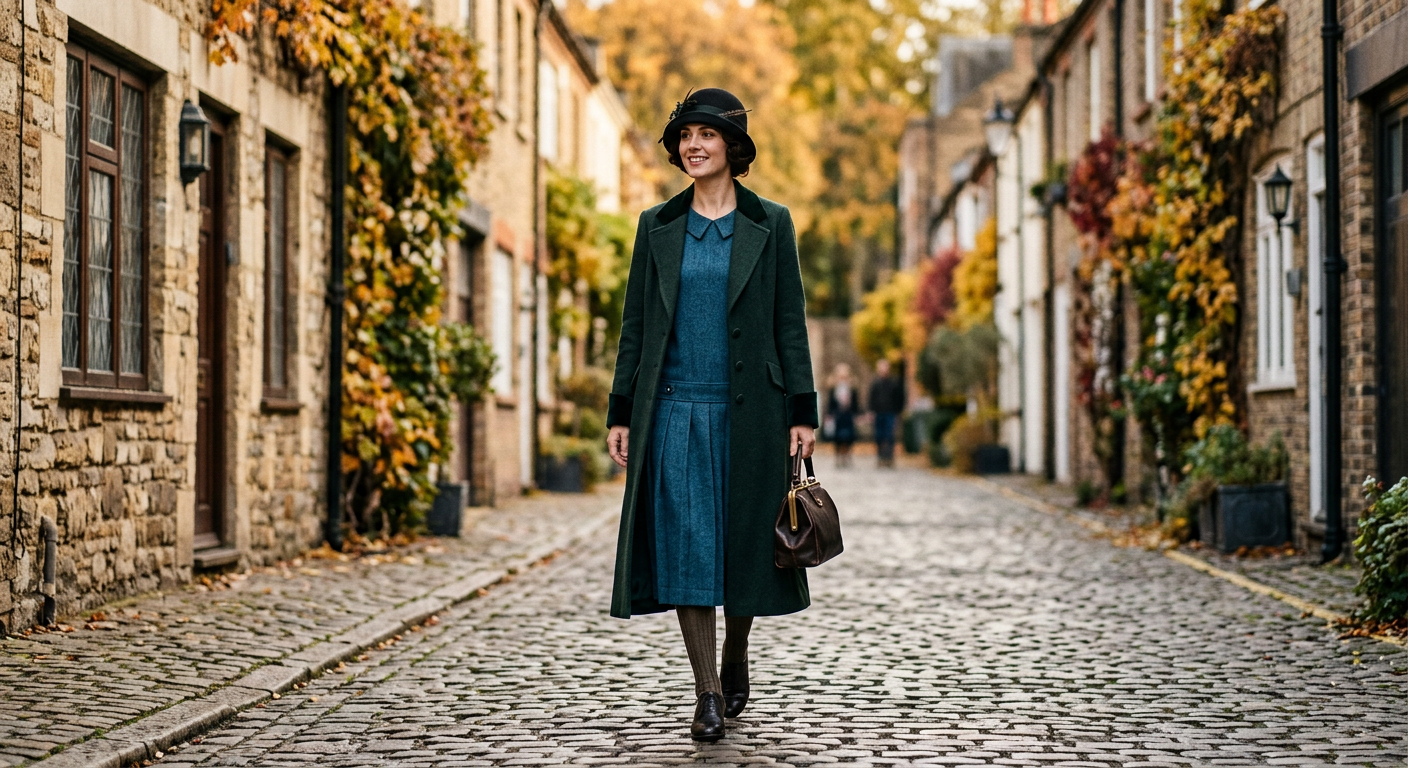
Hemlines for daytime garments were much more conservative than modern mythology suggests. In 1920 and 1921, day dresses floated modestly around the mid-calf or top of the ankle. It was not until approximately 1925 to 1927 that day skirts rose to their historic zenith—just skimming the bottom of the kneecap. By 1929, with the Wall Street Crash and the dawn of the Great Depression, hemlines plummeted back towards the calf and ankle almost immediately.
Colour palettes for daytime were similarly sophisticated. While summer months witnessed garden parties filled with pastel peach, mint, and cornflower blue, autumn and winter streets were dominated by rich, earthy shades: cocoa brown, bottle green, deep navy, russet, and heather tweed.
The Anatomy of the Cloche Hat and Daytime Outerwear
No 1920s daytime ensemble was considered socially decent without appropriate headwear and protective outerwear. Emerging from the millinery workshops of Parisian designer Caroline Reboux, the cloche hat (derived from the French word for "bell") became the undisputed monarch of millinery between 1923 and 1929.
Unlike the sprawling, plume-laden cartwheel hats of the Edwardian era that required long hatpins driven through intricate Gibson buns, the cloche was designed to be pulled snug and low over the newly sheared ears. It framed the cheekbones and necessitated a very specific female posture: women held their chins high and cast their gaze downward to see beneath the narrow, angled brims, creating an air of aloof, modern sophistication.
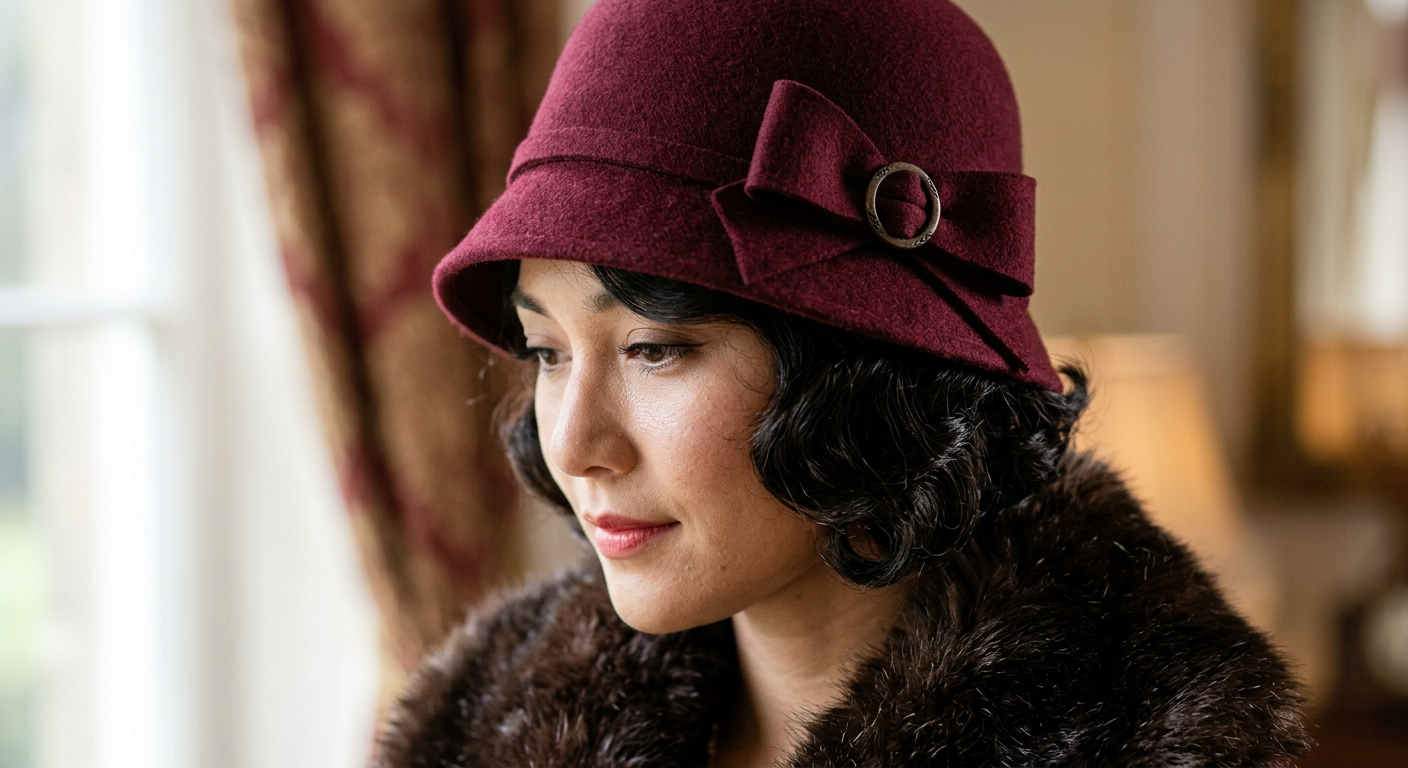
Cloches were masterfully crafted from blocked wool felt for winter dampness and hand-woven Sisal or Baku straw for spring sunshine. Milliners added subtle ribbons folded into geometric rosettes, which often carried coded messages: a tight knot signalled a woman who was happily married or spoken for, whereas an open, flamboyant bow indicated an independent spirit available for courtship.
To battle British dampness, daytime outerwear revolved around the cocoon coat. These voluminous, drop-shoulder wraps featured expansive dolman sleeves, deep armholes, and heavy shawl collars trimmed with plush fur (or faux astrakhan lamb). Fastened with a single substantial decorative button or held closed by crossing one arm across the body in an elegant protective gesture, cocoon coats enveloped the wearer like an Art Deco cocoon, providing dramatic contrast to the slender slip dresses worn beneath.
Channel Timeless 1920s Elegance
From drop-waist day dresses to hand-beaded Art Deco evening gowns and tailored cloche hats, discover the curated vintage collection crafted for authentic retro lovers.
Explore the 1920s CollectionRazzle Dazzle: Evening Wear, Flapper Dresses, and the Jazz Age
When twilight descended and the gramophones struck up the first syncopated bars of Duke Ellington or Fletcher Henderson, the functional sobriety of daywear vanished into a blaze of unrepentant, decadent luxury. This is the domain of the authentic flapper—the rebellious young woman who drank sidecars, applied cherry-red lipstick in public mirrors, drove fast roadsters, and danced the Charleston until dawn.
The authentic 1920s evening gown was a masterclass in kinetic textile engineering. Because popular jazz dances like the Black Bottom, the Lindy Hop, and the Shimmy demanded frenetic, uninhibited bodily movement, dresses had to move in intoxicating sympathy with the music. Designers achieved this kinetic poetry through several signature techniques:
- Weighty Micro-Glass Beading: French and Czechoslovakian bugle beads and seed beads were meticulously hand-sewn onto whisper-fine silk net or georgette. The sheer weight of thousands of glass beads caused the dress to skim the torso smoothly while generating intoxicating sound and liquid movement on the dance floor.
- Tiered Silk and Rayon Fringing: Unlike the cheap nylon fringe found on polyester costumes, original 1920s fringe was spun from dense silk floss. Attached in cascading tiers along skirts or across plunging scoop backs, it shimmered and spun outward when the dancer executed high kicks or rapid spins.
- Handkerchief and Asymmetrical Hemlines: Designers like Madeleine Vionnet used uneven godets, floating handkerchief points, and scalloped lace borders to provide visual modesty while stationary, but tease tantalising flashes of stockinged knee whenever the wearer danced.
- Sleeveless Cutaways and Plunging Backlines: While front necklines were often demurely bateau (boat-neck) or scooped, the back of an evening gown was frequently cut away down to the base of the spine, highlighting sun-kissed skin and glittering sautoir necklaces draped backward.
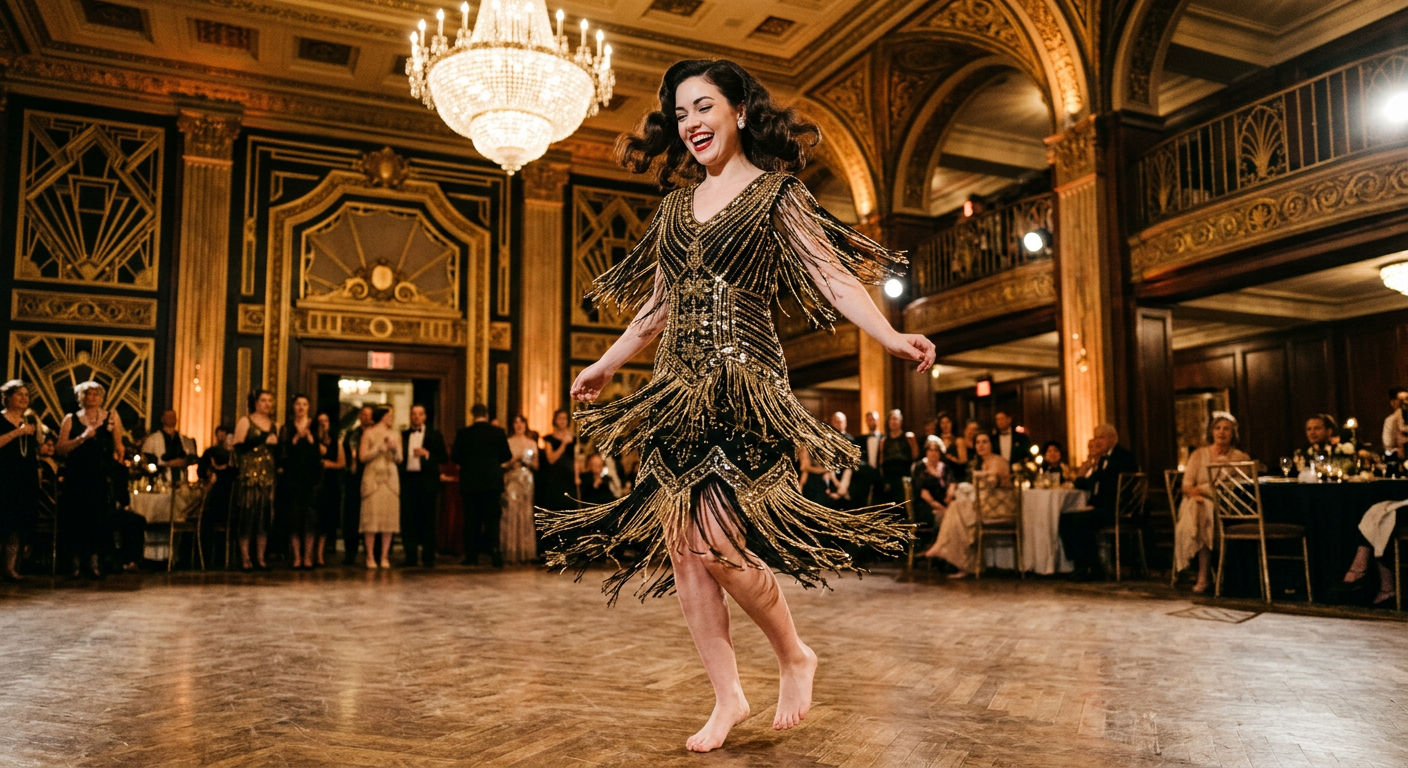
"In the nineteen-twenties, women didn’t just shorten their skirts to show off their ankles; they shortened them because you cannot dance the Charleston while dragging three yards of velvet train across the parquet."
The term "flapper" itself emerged from British slang, originally describing awkward young birds flapping their wings as they tested their flight, later applied to unconventional teenage girls who left their rubber overshoes unbuckled to flap noisily down the street. By 1925, it came to define an entire international sisterhood of hedonistic rebellion. Flappers were not merely passive mannequins; they were cultural agitators who transformed night clubs into egalitarian sanctuaries of female expression.
Fabrics, Colours, and Art Deco Embellishments
The decorative language of 1920s evening wear was deeply turbocharged by the 1925 Exposition Internationale des Arts Décoratifs et Industriels Modernes in Paris, which formally codified the Art Deco movement. Gone were the fluid, organic flora and curling tendrils of Edwardian Art Nouveau. In their place surged sharp chevrons, sunburst motifs, Aztec zigzags, chrome-like silver threads, and skyscraper geometry.
The discovery of King Tutankhamun’s intact tomb by Howard Carter in November 1922 ignited an insatiable fever for "Egyptomania" across Britain and the Western world. Overnight, evening wraps, smoking jackets, and party gowns were drenched in lapis lazuli blues, scarab greens, rich carnelian reds, and hieroglyphic lotus-flower embroidery. Gilded metallic lamé, produced by interweaving genuine metallic threads with silk warps, draped around socialites like molten liquid gold.
The decade also witnessed the commercial triumph of artificial silk (rayon), marketed under trade names like Celanese. For the first time, working-class shopgirls and factory hands could purchase high-sheen, slinky evening dresses that mimicked pure mulberry silk charmeuse for a fraction of the cost, obliterating class distinctions under the low amber lights of local dancehalls.
Undergarments of the Roaring Twenties: From Rigid Stays to Step-Ins
It is an inviolable fashion truth that an exterior silhouette cannot exist without its underpinning foundations. The dramatic, flat-chested, tubular silhouette of the 1920s was only made possible through a total revolution in women's intimate apparel. One could not wear a fragile, slip-style Chanel dress over steel-and-whalebone corsetry without tearing the delicate fabric to ribbons.
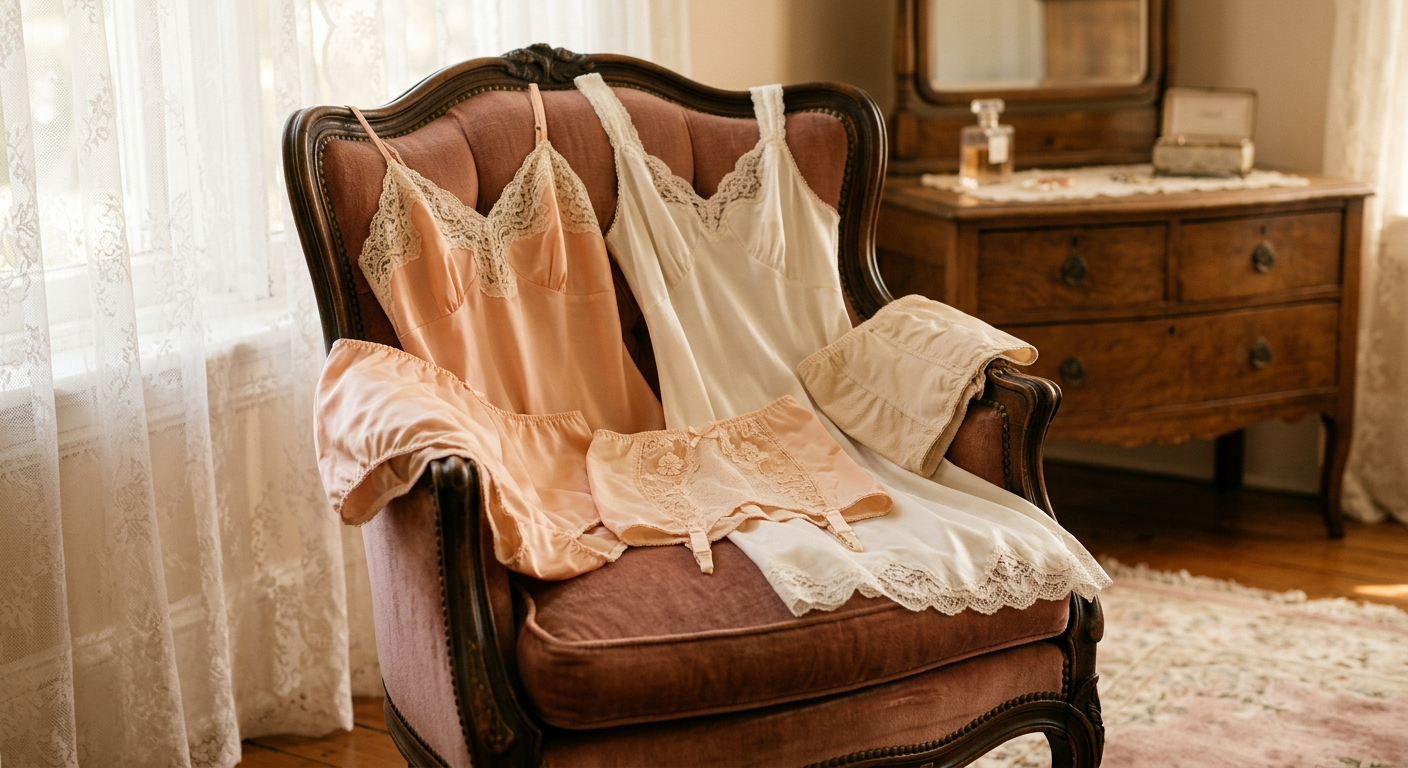
Women discarded heavy stays in favour of the newly invented bandeau bra or "bust flattener." Unlike modern push-up bras or the sculpted bullet bras of the 1950s pin-up era, the 1920s bandeau was a simple strip of cotton mesh, linen, or elasticised silk that pressed the natural bosom flat against the ribs, minimising cleavage and supporting the boyish chest line demanded by high fashion.
Below the waist, women wore lightweight step-in combinations, colloquially known as camiknickers or teddies. These whisper-weight garments combined a camisole top and loose bloomer knickers with a buttoned crotch flap, crafted from peach or ivory silk crêpe de Chine trimmed with delicate Valenciennes lace. For gentle hip smoothing without constriction, women turned to elasticised roll-on girdles fitted with rubber garters to suspend their sheer stockings.
1920s Footwear & Accessories: T-Straps, Pearls, and Vanity Cases
Because hemlines had risen dramatically above the floor for the first time in centuries, women's shoes and lower legs were suddenly thrust into sharp public focus. Footwear transformed from sturdy, hidden utilitarian boots into glittering, sensual fashion statements.
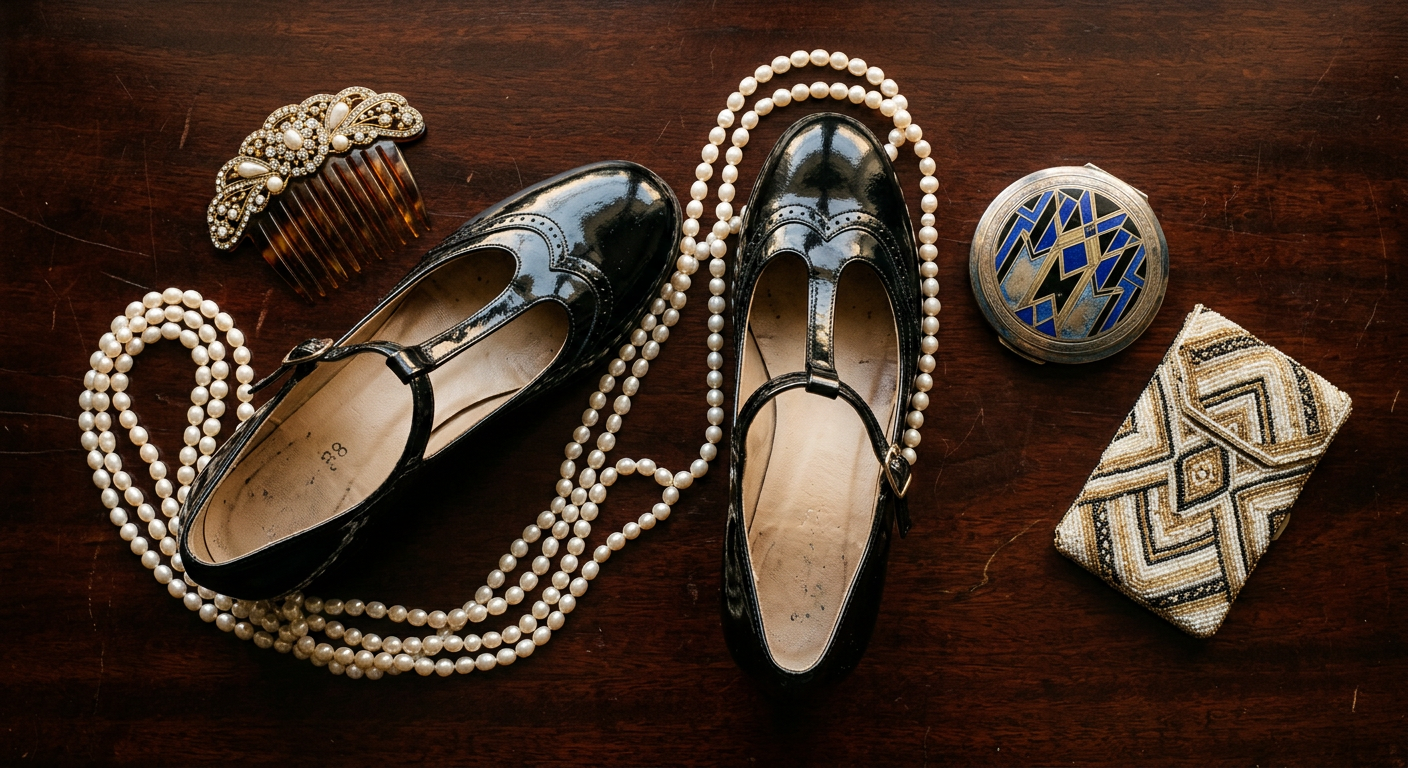
The definitive shoe of the Roaring Twenties was the T-strap heel (known across France and Britain as the salomé) alongside the single-buckle Mary Jane. These shoes featured a sensible, curved, two-to-three-inch Cuban or Louis heel that provided stability on chaotic dance floors, while the horizontal and vertical ankle straps guaranteed that the shoe would not fly off during vigorous Charleston kicks. Evening shoes were rendered in jewel-toned satin, gold kidskin leather, or black patent, often elevated with diamanté-encrusted buckles or hand-painted enamel heels.
Stockings were equally essential. Women traded black woollen and cotton hosiery for ultra-fine stockings made from natural silk or lustrous rayon in warm flesh tones such as "nude," "peach," and "sun-tan." Playful flappers wore stockings with intricate decorative patterns known as "clocks" embroidered up the side of the ankle, and rebellious young women were famously reported to roll their stockings below their knees, dusting their kneecaps with scented rose talcum powder before heading out to illicit parties.
The Essential 1920s Accessory Checklist
- The Sautoir Necklace: Ropes of imitation or freshwater seed pearls measuring up to sixty inches in length, worn knotted at the breastbone or slung down the bare spine.
- The Beaded Reticule or Mesh Purse: Delicate metal mesh bags stamped with geometric Art Deco enamelling or hand-beaded drawstring pouches carried just enough room for carfare, keys, and cosmetics.
- The Enamelled Vanity Compact: Because powdering one's nose in public became the ultimate hallmark of the liberated flapper, women carried exquisite silver, jade, and lacquer compacts containing pressed powder, rouge, and mirrored lids.
- The Bakelite Cigarette Holder: Long tortoiseshell, amber, or marbled Bakelite holders kept tobacco smoke away from delicate silk dresses while framing dramatic hand gestures.
- The Feathered Headband: Reserved exclusively for high-glamour evening affairs, narrow bands of metallic cord, seed pearls, or velvet hugged the brow, punctuated by a single upright egret plume or glittering rhinestone clip.
How to Channel 1920s Glamour into Your Modern Vintage Wardrobe
The enduring magic of 1920s womenswear lies in its extraordinary versatility. Unlike the heavily structured, petticoat-dependent silhouettes of Victorian crinolines or 1950s rockabilly swing dresses, Roaring Twenties pieces possess an airy, languid nonchalance that harmonises effortlessly with contemporary high-street wardrobes.
To avoid looking like an extra in an amateur theatrical production, the secret to modern 1920s styling is subtle curation. Rather than assembling a head-to-toe ensemble featuring a plastic feathered headband, plastic pearls, and fringed nylon at the same time, anchor your look around one authentic, high-quality statement piece and balance it with clean, contemporary tailoring.
Curate Your Authentic Retro Wardrobe
Fall in love with our premium collection of drop-waist bias cuts, Art Deco accessories, and velvet layers inspired by the timeless spirit of the 1920s.
Shop Vintage DressesConsider these three foolproof modern styling formulas:
- The Daywear Crossover: Pair a fine wool or silk pleated drop-waist midi skirt with a fitted cropped knit cardigan (a nod to 1950s pin-up polish) and leather Oxford brogues. Finish with a structured wool cloche hat for crisp autumn city strolls.
- The Modern Art Deco Soirée: Select a bias-cut black silk velvet or heavily beaded slip dress that falls to mid-calf. Skip the feather headband entirely; instead, style your hair into clean finger waves, add architectural geometric Art Deco earrings, and slip into classic leather T-bar pumps.
- The Bohemian Cocoon: Throw an embroidered devoré velvet wrap coat with a faux-fur shawl collar over a pair of tailored high-waisted trousers and a simple silk camisole. You achieve instant 1920s Bloomsbury Group literary sophistication with total modern comfort.
Frequently Asked Questions About 1920s Women's Fashion
- Did women really wear short skirts in the 1920s?
- While popular imagination envisions micro-minis, 1920s skirts were never that short. Early in the decade, hemlines sat around mid-calf. At their shortest point between 1926 and 1927, skirts reached just below the bottom of the kneecap. Because women had covered their ankles for centuries, showing the knee and calf was considered deeply scandalous and revolutionary at the time.
- What did ordinary women wear on a daily basis in the 1920s?
- Ordinary working and middle-class women wore practical cotton wrap house dresses for chores, tailored wool two-piece walking suits with pleated skirts for office work, and breathable wool jersey jumper dresses paired with sturdy low Cuban-heeled shoes and cloche hats for daily errands and social calls.
- Did 1920s women stop wearing corsets entirely?
- Corsetry was not discarded so much as fundamentally re-engineered. Heavy Victorian steel and whalebone cages were cast aside in favour of lightweight, flexible step-in girdles made of elastic mesh and rubber, paired with bandeau bust flatteners designed to smooth the waist and flatten the bosom into a youthful, tubular silhouette.
- What were 1920s day dresses called?
- Day dresses were known by various names according to their function, including house frocks, Hooverettes, apron frocks, walking suits (tailleurs), jersey jumper dresses, and afternoon tea frocks. The overarching cut was commonly referred to as the chemise dress or the sacque dress.
- Did women wear trousers in the 1920s?
- Trousers were not yet accepted for general public daywear or formal occasions. However, avant-garde women, bohemian artists, and high-fashion socialites began wearing voluminous silk or satin "pyjama" sets for lounging at home, beach holidays in the French Riviera, and private garden parties, paving the way for everyday women's trousers in later decades.
- What shoes did 1920s women wear?
- The most iconic shoes of the era were T-strap (salomé) heels, single-strap Mary Janes, and lace-up Oxford shoes. They typically featured a curved, stable Cuban or Louis heel measuring between two and three inches, designed for balance and vigorous jazz dancing.
- How can I style a 1920s look today without looking like a costume party?
- Avoid mass-manufactured fancy-dress costume sets with plastic sequins and synthetic fringe. Instead, invest in well-tailored vintage reproductions or authentic antique pieces: a genuine bias-cut drop-waist dress, authentic leather Mary Jane shoes, a wool felt cloche, or an Art Deco geometric clutch. Keep makeup clean with a bold berry lip and soft finger waves.
One century after its birth, the fashion of the Roaring Twenties continues to enchant, embolden, and inspire. By trading architectural tyranny for fluidity, weight for levity, and rigid etiquette for individual verve, the women of the 1920s didn't just alter their wardrobes; they unlocked the modern world. Slipping into a dropped-waist silhouette or clipping a sparkling Art Deco comb into your hair is more than a style statement—it is an affectionate salute to the fierce, free-spirited women who paved the dance floor of freedom for us all.